Dendroprop: Learning to link somatic and dendritic inputs over long timescales
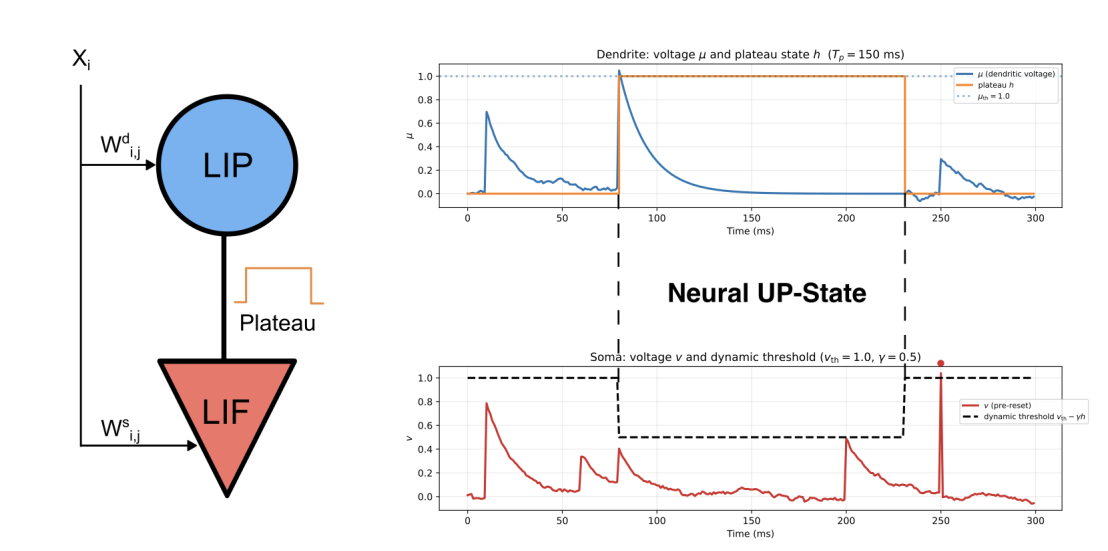
A two-compartment neuron model in which NMDA-like plateau potentials link dendritic and somatic spike patterns, trained with a new surrogate-gradient rule.
Introduction
The single-compartment Leaky Integrate-and-Fire (LIF) neuron is the standard model of spike-based computation in both neuroscience and machine learning. This is the case despite overwhelming evidence that computation in pyramidal neurons is strongly driven by active dendritic processes that respond to inputs locally within complex dendritic trees [1]. The gap persists largely because the field lacks clear principles for how dendrites contribute to computation.
Here we investigate one specific dendritic mechanism: NMDA-mediated plateau potentials, or NMDA spikes [2]. Unlike typical excitatory postsynaptic potentials (EPSPs), which integrate incoming inputs approximately linearly as they enter the cell, NMDA spikes are highly non-linear and produce long-lasting voltage depolarizations in the dendrite that can persist for hundreds of milliseconds. They are elicited whenever sufficiently coincident synaptic input arrives across multiple nearby synapses. In vitro experiments have demonstrated their reliable activation in both apical and basal dendrites, as well as their larger somatic impact compared with EPSPs [3], yet their computational benefit remains largely unexplored.
We hypothesize that the key contribution of NMDA spikes is the ability to bind temporally dispersed spike patterns robustly over long time windows. When the dendritic compartment detects a transient spike pattern, it generates a plateau potential, placing the neuron in an UP state. This state biases pattern recognition in the somatic compartment towards patterns occurring within one plateau duration, thereby binding dendritic and somatic patterns into a single output response.
Methods
Model
To test this hypothesis, we developed a two-compartment model consisting of a LIF soma coupled to a dendritic compartment that generates plateau potentials. The plateau acts on the soma by reducing its firing threshold, modelling the elevated excitability of a neural UP state for the duration of the plateau. Plateau duration is sampled from a uniform range of reported in vitro durations and is fixed per neuron.
Learning rule
We derived a new surrogate gradient descent learning rule [3] for this model. Its key property is that credit is assigned to dendritic synapses that elicited a plateau potentially hundreds of milliseconds before the coupled somatic output that affects the error. The rule also rewards dendritic synapses based on whether somatic spikes occur during the plateau at all, regardless of their specific timing within it. The model can therefore learn to associate spike patterns up to a plateau length apart, enabling effective learning of long-range temporal dependencies.
Results
We evaluated our model against a parameter-matched LIF network on two benchmark datasets. On the Neuromorphic-MNIST dataset [3], which can be solved without temporal information, our model matched the LIF network performance (both 98% accuracy). On the Spiking Heidelberg Digits [4], which requires temporal information, our model improved significantly over the LIF network (93% vs. 74% accuracy), demonstrating that plateaus significantly aid temporal processing. In both cases, our model learned various temporally dispersed pattern pairs as features, supporting our hypothesis that plateaus bind spike patterns for recognition.
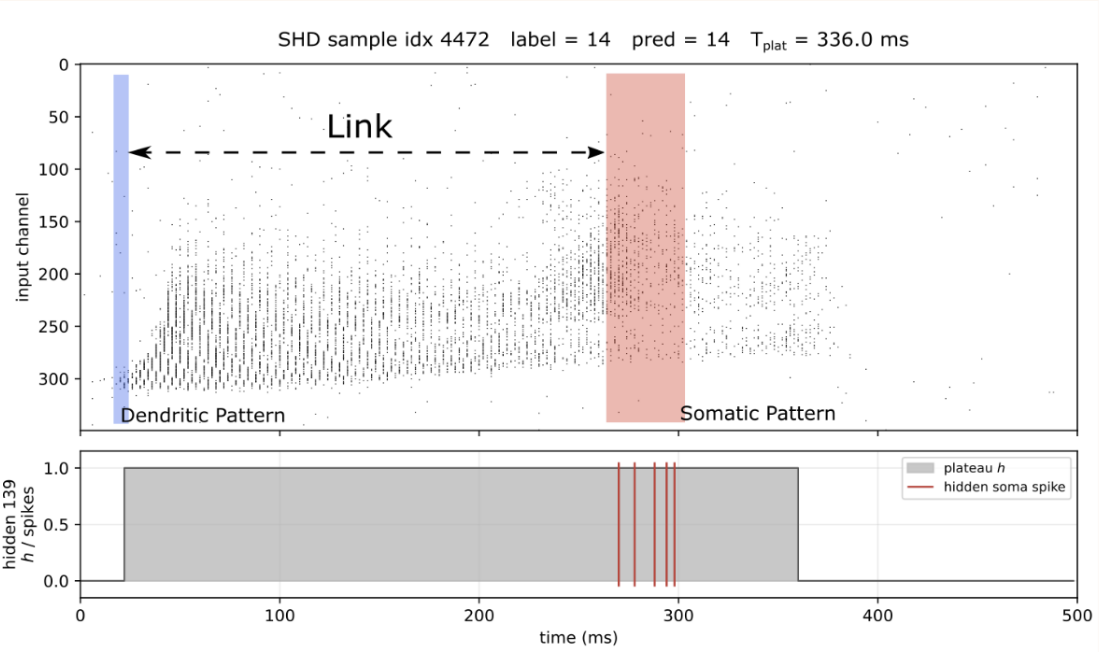
In sum, we showed that dendritic plateaus turn neurons into multi-timescale pattern detectors.
This general computational function aligns with specific capabilities assigned to dendrites, such as memory traces [5] or sequence processing [6]. The clear advantages of our plateau-then-spike model over LIF neurons strongly advocate for the integration of dendritic computation into neuron models from both practical and theoretical perspectives.
References
London, M., & Häusser, M. (2005). Dendritic computation. Annual Review of Neuroscience, 28, 503–532. https://doi.org/10.1146/annurev.neuro.28.061604.135703
Neftci, E. O., Mostafa, H., & Zenke, F. (2019). Surrogate gradient learning in spiking neural networks. IEEE Signal Processing Magazine, 36(6), 51–63. https://doi.org/10.1109/MSP.2019.2931595
Orchard, G., Jayawant, A., Cohen, G. K., & Thakor, N. (2015). Converting static image datasets to spiking neuromorphic datasets using saccades. Frontiers in Neuroscience, 9, 437. https://doi.org/10.3389/fnins.2015.00437
Cramer, B., Stradmann, Y., Schemmel, J., & Zenke, F. (2022). The Heidelberg spiking data sets for the systematic evaluation of spiking neural networks. IEEE Transactions on Neural Networks and Learning Systems, 33(7), 2744–2757. https://doi.org/10.1109/TNNLS.2020.3044364
Quaresima, A., Fitz, H., Duarte, R., van den Broek, D., Hagoort, P., & Petersson, K. M. (2023). The Tripod neuron: A minimal structural reduction of the dendritic tree. Journal of Physiology, 601(15), 3265–3295. https://doi.org/10.1113/JP283399
Leugering, J., Nieters, P., & Pipa, G. (2023). Dendritic plateau potentials can process spike sequences across multiple time-scales. Frontiers in Cognition, 2, 1044216. https://doi.org/10.3389/fcogn.2023.1044216